Crafting Depth: The 3D Layered Flower Mandala
In the world of digital fabrication and handmade decor, there is a distinct difference between a flat cutout and a piece that commands attention through dimension. The 3d Layered Flower Mandala represents this shift from two-dimensional simplicity to three-dimensional complexity. For creators, small business owners, and hobbyists looking to elevate their portfolio, understanding how to leverage layered designs is essential. This specific design, often referred to as the F12 model, offers a practical blueprint for achieving professional-grade results using accessible technology. It is not merely a pattern; it is a structural exercise in precision, material selection, and assembly that can transform a standard crafting session into a sophisticated production process.
Understanding the Architecture of Layered Design
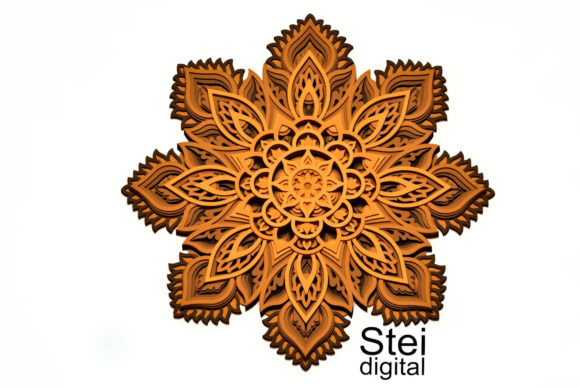
At its core, the 3d Layered Flower Mandala is an exercise in stacking. Unlike traditional laser cutting projects that result in a single plane of material, this approach utilizes eight distinct layers to build volume. The F12 variant specifically is engineered with a total depth of 24 mm, creating a substantial presence while maintaining a height and length of 287 mm. These dimensions are scalable, allowing makers to adapt the design for everything from intricate jewelry displays to large-scale wall art.
The magic lies in the separation of files. When you acquire this design, you are not receiving a single image to cut. Instead, the package includes eight individual DXF files and eight individual SVG files, each representing a specific stratum of the flower. This separation is critical. It allows the operator to control the cutting order, manage material waste efficiently, and ensure that the registration points align perfectly during assembly. For those using software like LightBurn or Adobe Illustrator, having discrete layers means you can assign different cut settings to specific parts if you choose to experiment with varying material densities, although uniformity is generally recommended for this specific aesthetic.
Machine Compatibility and Material Selection
One of the most significant advantages of the F12 mandala design is its versatility across different cutting platforms. Whether you operate a high-powered CNC laser in a professional workshop or rely on a desktop Cricut or Silhouette in a home studio, this file set is optimized for your equipment. The inclusion of a consolidated SVG file containing all layers makes it particularly "Cricut-friendly," streamlining the upload process for users who prefer the Design Space ecosystem. However, the individual layer files remain available for those who need granular control over their cutting sequence on more industrial machines.
Material choice is where the tactile quality of the 3d Layered Flower Mandala truly comes to life. The design specifies a material thickness between 2 mm and 4 mm. This range is deliberate. Using 2 mm stock will result in a more delicate, intricate appearance, ideal for hanging ornaments or lightweight decor. Conversely, opting for 4 mm plywood or acrylic creates a bold, architectural statement piece that casts significant shadows and interacts dynamically with light. Common materials include birch plywood for a natural, warm finish, or colored acrylics for a modern, vibrant look. The 24 mm total depth achieved by stacking eight layers of 3 mm material (or combinations thereof) provides enough shadow play to make the floral patterns pop without becoming too heavy for wall mounting.
Practical Applications for Creators and Entrepreneurs
For freelancers and small business owners, time efficiency and product uniqueness are currency. The 3d Layered Flower Mandala addresses both. Because the files are pre-separated and archived, the setup time is minimized. Users simply need to extract the folders using tools like WinRAR or an online extractor, import the files, and begin production. There is no need to spend hours vectorizing images or manually separating layers, which reduces the barrier to entry for selling handmade goods.
Consider the use case of a wedding decor specialist. A flat paper flower is common; a 24 mm deep wooden mandala is a centerpiece. By utilizing the scalable nature of the DXF and SVG files, a creator can produce a matching set of table numbers, cake toppers, and backdrop elements that share a cohesive design language but vary in size. Similarly, educators teaching STEM or art classes can use this project to demonstrate principles of geometry, symmetry, and structural engineering. The process of assembling eight layers teaches patience and spatial reasoning, providing a meaningful educational outcome beyond simple crafting.
Maximizing Efficiency with Organized File Structures
The organization of the digital assets provided with the F12 design reflects a professional workflow. Receiving eight DXF files and eight SVG files in separate archives ensures that whether you are a veteran CNC operator or a novice crafter, the data is ready for immediate use. The DXF format is the industry standard for laser cutters, ensuring precise path generation, while the SVG format bridges the gap for web-based design tools and consumer-grade cutters.
It is important to note the technical requirement of extracting these files. Since they are archived to keep the package manageable, users must have access to extraction software. This small step ensures file integrity and prevents corruption during download. Once extracted, the individual layer files allow for a "cut-as-you-go" approach. If you are limited by machine bed size, you can cut layers in batches. If you are experimenting with a gradient effect, you can cut layers from different shades of wood or acrylic, assembling them to create a fading color profile that adds even more visual depth to the 3d Layered Flower Mandala.
Strategic Considerations and Limitations
While the benefits of layered manufacturing are clear, successful execution requires attention to detail. The primary challenge with any multi-layer project is alignment. With eight layers stacking to a height of 287 mm, even a minor misalignment of half a millimeter per layer can result in a noticeable skew at the top of the structure. Makers should consider using registration marks or a jig during the gluing process to maintain perfect symmetry. Additionally, the choice of adhesive matters; fast-setting cyanoacrylate works well for small contact points, while wood glue may be preferable for larger surface areas on plywood, though it requires clamping time.
Furthermore, while the dimensions are scalable, users must respect the aspect ratio. Distorting the width or height independently will ruin the geometric integrity of the mandala, causing the layers to mismatch. When resizing, always lock the aspect ratio in your design software. Also, consider the kerf of your specific machine. If you are using a laser with a wide kerf, you may need to adjust the fit of interlocking tabs if the design includes them, though this specific floral stack primarily relies on surface bonding.
Elevating Your Creative Output
Ultimately, the value of the 3d Layered Flower Mandala F12 lies in its ability to bridge the gap between digital precision and organic beauty. It allows marketers and bloggers to create unique visual content that stands out in a saturated social media feed. It enables publishers to offer tangible, high-value inserts or covers. For the individual hobbyist, it offers the satisfaction of building something complex from simple sheets of material.
By leveraging the specific constraints of the 2-4 mm material thickness and the eight-layer architecture, creators can produce items that feel expensive and thoughtfully designed. The transition from a flat SVG on a screen to a 24 mm deep physical object is a powerful reminder of what digital fabrication can achieve. Whether used for personal decoration, educational demonstration, or commercial resale, this design serves as a robust foundation for innovation. It encourages users to think in Z-axes, not just X and Y, fostering a deeper understanding of space and form in their creative endeavors.