Integrating Japanese Bamboo Wall Art SVG Geisha Designs into Modern Digital Fabrication
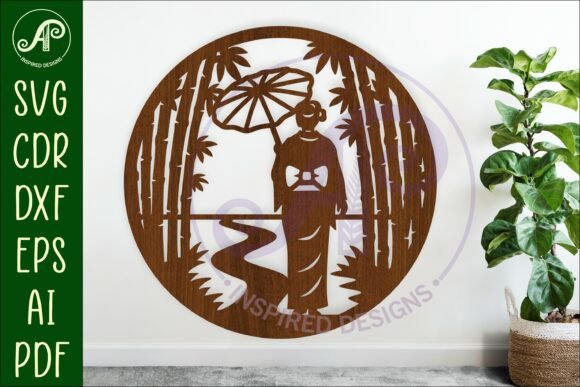
The intersection of traditional Eastern aesthetics and modern digital fabrication has opened new avenues for interior designers, hobbyists, and small business owners. Among the most compelling designs available for laser cutting and CNC routing is the Japanese Bamboo Wall Art SVG - Geisha. This specific motif combines the serene, structural elegance of bamboo with the cultural richness of the Geisha figure, creating a piece that serves as both a decorative element and a conversation starter. Unlike mass-produced decor, utilizing digital download files allows creators to customize scale, material, and finish, ensuring that the final installation fits perfectly within its intended environment, whether that be a rustic cabin, a modern office, or an educational setting.
Understanding the workflow and potential of these digital assets requires a shift from viewing them merely as images to seeing them as precise engineering instructions. The files provided in formats such as SVG, AI, PDF, CDR, and DXF are not just pictures; they are vector-based roadmaps that tell a machine exactly where to cut, score, or engrave. When a creator purchases a listing for a Japanese Bamboo Wall Art SVG - Geisha, they are acquiring the intellectual property rights to manufacture a physical object based on that design. The standard dimensions often suggested, such as a height of 26cm (approximately 10.3 inches), serve as a baseline, but the true power of vector graphics lies in their scalability. A design can be enlarged to span an entire wall in a restaurant or reduced to fit a jewelry box lid without losing any resolution or detail.
The Technical Advantages of Multi-Format Vector Files
For professionals and serious hobbyists, the versatility of file formats is paramount. A high-quality digital download package typically includes a zip folder containing multiple file types to ensure compatibility with various software ecosystems. The SVG (Scalable Vector Graphics) format is universally recognized and works seamlessly with web-based design tools and entry-level cutting machines like the Cricut or Silhouette. It defines shapes using mathematical paths rather than pixels, which is why the image remains crisp regardless of how much it is resized.
However, industrial applications often require more robust formats. The AI (Adobe Illustrator) file is essential for graphic designers who need to modify anchor points, adjust bezier curves, or integrate the Geisha design into a larger composite artwork. For those operating in a Windows environment or using specialized CAD software, the DXF (Drawing Exchange Format) is the industry standard. It ensures that the cut lines are interpreted correctly by computer-aided manufacturing systems, minimizing the risk of machine errors during the cutting process. Furthermore, the inclusion of CDR files caters specifically to users of CorelDRAW, a favorite among sign-makers and laser engraving shops. Finally, the PDF acts as a universal viewer and a reliable backup for printing proofs or sending to clients who may not have specialized design software.
A critical feature found in professional-grade files for laser cutting is the use of color-coded layers. In the context of the Japanese Bamboo Wall Art SVG - Geisha, exterior cut lines are often designated in blue. This is not an aesthetic choice but a functional one. Laser software, such as LightBurn or the proprietary software accompanying Glowforge machines, can be configured to recognize specific colors as commands. A blue line might instruct the laser to cut all the way through a 3mm plywood sheet, while a black line might indicate a surface engrave. This separation simplifies the setup process, allowing the operator to assign power and speed settings to specific colors instantly, thereby reducing setup time and material waste.
Material Selection and Aesthetic Application
The visual impact of the Japanese Bamboo Wall Art SVG - Geisha is heavily dependent on the material chosen for fabrication. While the digital file provides the shape, the material provides the soul of the piece. For a cabin or a home with rustic decor, natural woods like birch plywood, maple, or walnut are excellent choices. The grain of the wood interacts with the laser burn, adding depth and texture to the bamboo stalks and the intricate details of the Geisha's kimono. When cut from light-colored wood, the design offers a subtle, organic look that blends well with neutral interiors. Conversely, using darker woods like mahogany or staining the wood post-cut can create a dramatic, high-contrast silhouette that stands out against lighter walls.
Beyond wood, these vector files open the door to experimenting with acrylics and metals. Clear or frosted acrylic can be used to create modern, translucent wall art that plays with light. When backlit, the negative spaces between the bamboo stalks glow, creating an ethereal effect that honors the spiritual connotations often associated with bamboo in Japanese culture. For outdoor applications or high-traffic commercial spaces, aluminum composite material can be cut using the same DXF files, providing durability against the elements while maintaining the elegance of the design. The ability to resize the file means that a creator can test a small prototype in acrylic before committing to a large, expensive sheet of hardwood.
Consider the application of this design in a commercial setting, such as a sushi restaurant or a tea house. A large-scale version of the Japanese Bamboo Wall Art SVG - Geisha can serve as a focal point behind the reception desk or as a divider between dining areas. The bamboo motif symbolizes resilience and flexibility, while the Geisha represents artistic refinement. Together, they communicate a brand identity rooted in tradition and quality. Educators and researchers studying Japanese culture might also utilize these designs to create tactile learning aids or museum displays, where the precision of laser cutting ensures that historical details are represented accurately.
Workflow Optimization for Makers and Businesses
Integrating digital downloads into a production workflow requires attention to detail, particularly regarding file preparation. Upon downloading the zip folder, the first step is always extraction and inspection. Users should open the files in their preferred software to verify that all paths are closed and that there are no stray nodes that could cause the laser head to make unnecessary movements. Since the listing specifies that the design is formatted with exterior cut lines in blue, users must ensure their software interprets this color correctly. If the design needs to be resized from the default 26cm to a custom dimension, it is crucial to scale the entire group of objects proportionally to maintain the aspect ratio. Distorting the image can lead to structural weaknesses in the final cut, especially in delicate areas like the fingers of the Geisha or the leaves of the bamboo.
For business owners selling handmade goods, the efficiency of using pre-designed vectors cannot be overstated. Instead of spending hours drawing complex illustrations, a maker can focus on material sourcing, finishing, and marketing. The Japanese Bamboo Wall Art SVG - Geisha serves as a reliable product base. A single purchase allows for unlimited production runs, making it ideal for craft fairs, Etsy shops, or custom commission work. However, it is important to remember that while the file is a tool, the craftsmanship comes from the maker. Sanding edges, applying finishes, and choosing the right mounting hardware are what transform a digital file into a premium physical product.
Additionally, the layered nature of some laser cut projects allows for 3D assembly. Although the basic file might be a single layer, creative users can duplicate the design, cut multiple layers from different colored woods, and stack them to create depth. This technique, known as "layered laser cutting," can give the Japanese Bamboo Wall Art SVG - Geisha a shadow-box effect, enhancing the perception of three-dimensionality. This approach adds value to the final product, allowing creators to charge a higher price point for what is essentially the same digital asset used in a more innovative way.
Considerations for Scaling and Precision
One of the most significant advantages of vector-based art is the freedom to scale. Whether the project requires a miniature ornament or a monumental wall installation, the mathematics of the vector file ensure fidelity. However, practical considerations arise when scaling extremes. When enlarging the Japanese Bamboo Wall Art SVG - Geisha significantly, the width of the cut lines relative to the overall size becomes negligible, which is generally favorable. Yet, when shrinking the design below a certain threshold, fine details may become too fragile to survive the cutting process or handling. For instance, the thin gaps between bamboo stalks might merge if the design is made too small for the kerf (width of the laser cut) of the machine being used.
Makers must understand the limitations of their specific machinery. A desktop hobby laser has different capabilities compared to an industrial CO2 laser. The former might struggle with thick materials or extremely fine details at small scales, while the latter excels in precision. Therefore, testing is essential. Before cutting the final material, it is advisable to run a test cut on a scrap piece of the same material and thickness. This confirms that the blue exterior cut lines are recognized as cuts and not engravings and that the sizing is appropriate for the intended display location.
Furthermore, the context of the installation dictates the optimal size. In a spacious living room with high ceilings, a 10.3-inch sign might get lost visually. Resizing the file to 60cm or even 1 meter tall allows the artwork to command the space. Conversely, for a gift item or a shelf decoration, the original 26cm height is likely perfect. The digital nature of the product empowers the user to make these decisions dynamically, adapting the art to the architecture rather than forcing the architecture to accommodate the art.
Cultural Resonance and Design Integrity
When working with culturally significant imagery like the Geisha and bamboo, maintaining design integrity is crucial. The Japanese Bamboo Wall Art SVG - Geisha is not just a random collection of shapes; it is a representation of specific cultural symbols. Bamboo in Japanese culture is often associated with strength, purity, and good luck, while the Geisha is a symbol of traditional feminine beauty and artistic mastery. A well-executed laser cut preserves the grace of these lines. Poorly scaled or improperly cut versions can distort these features, inadvertently disrespecting the source material.
Creators have a responsibility to handle such designs with care. This involves not only technical precision but also an appreciation for the aesthetic balance. The flow of the bamboo stalks should guide the eye naturally toward the Geisha figure. The negative space—the areas cut away—is just as important as the positive space in defining the form. High-quality SVG and DXF files are engineered to optimize this balance, ensuring that the structural integrity of the material supports the artistic vision. By respecting these nuances, makers produce work that resonates authentically with viewers, bridging the gap between digital precision and human emotion.
In conclusion, the availability of comprehensive digital packages containing SVG, AI, PDF, CDR, and DXF files for designs like the Japanese Bamboo Wall Art SVG - Geisha represents a significant resource for the modern maker community. It democratizes access to high-quality design, allowing individuals from diverse backgrounds to create professional-grade decor. By understanding the technical specifications, selecting appropriate materials, and respecting the cultural context of the design, users can transform simple digital data into enduring works of art that enhance any space. The journey from a downloaded zip folder to a finished wall sign is a testament to the power of combining traditional motifs with contemporary technology.